


Codex + Cloudflare
OpenAILightweight open-source terminal agent that reads and writes files, runs commands, and browses the web in a sandbox. Made by OpenAI.
-
Install Codex
Install the Codex CLI. macOS and Linux are fully supported; use WSL2 on Windows. For Homebrew or other install methods, see the Codex CLI setup guide ↗.
Terminal window npm install -g @openai/codex -
Launch Codex in your project
Start Codex from the root of your project, where
wrangler.jsonclives (if it already exists).Terminal window codex -
Install the Cloudflare plugin
Inside Codex, run
/plugins, then search for and install Cloudflare. This installs Cloudflare Skills and registers the Cloudflare MCP servers./plugins -
Try a prompt
For example:
Configure caching rules and cache TTLs to reduce origin load for my e-commerce store.
-
Download Codex
Follow the download instructions for your operating system at developers.openai.com/codex/app ↗.
-
Install the Cloudflare plugin
In the Codex app, go to Plugins and install Cloudflare.
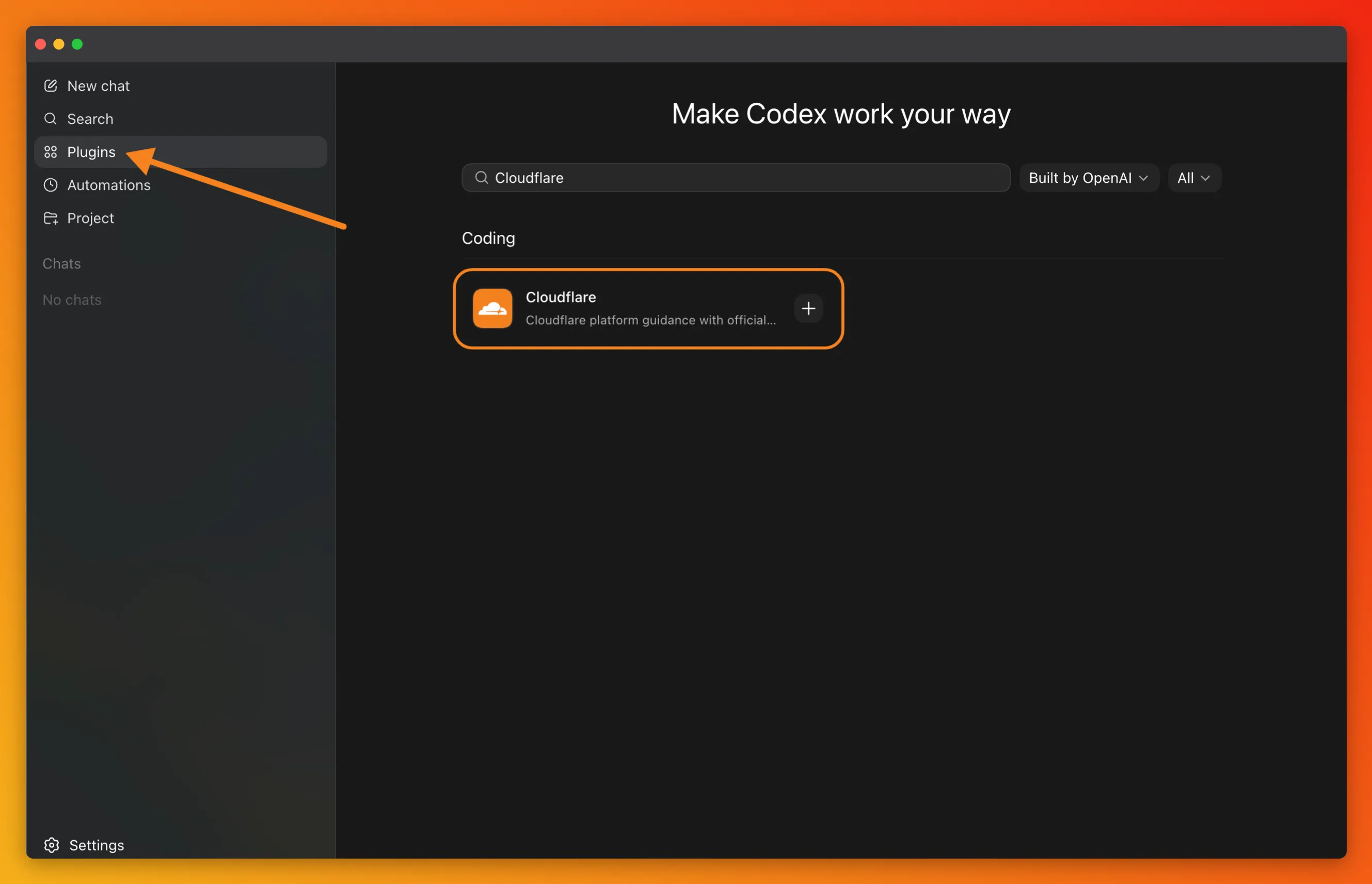
Expand any section to learn more.
Cloudflare Skills
Persistent platform context that teaches the agent how Cloudflare works.
Skills are instructions the agent loads on demand. The cloudflare/skills bundle covers every layer of the platform — so the agent knows your conventions without you re-explaining them.
- agents-sdk Build AI agents on Cloudflare Workers using the Agents SDK. Load when creating stateful agents, durable workflows, real-time WebSocket apps, scheduled tasks, MCP servers, chat applications, voice agents, or browser automation. Covers Agent class, state management, callable RPC, Workflows, durable execution, queues, retries, observability, and React hooks. Biases towards retrieval from Cloudflare docs over pre-trained knowledge.
- cloudflare Comprehensive Cloudflare platform skill covering Workers, Pages, storage (KV, D1, R2), AI (Workers AI, Vectorize, Agents SDK), feature flags (Flagship), networking (Tunnel, Spectrum), security (WAF, DDoS), and infrastructure-as-code (Terraform, Pulumi). Use for any Cloudflare development task. Biases towards retrieval from Cloudflare docs over pre-trained knowledge.
- cloudflare-email-service Send and receive transactional emails with Cloudflare Email Service (Email Sending + Email Routing). Use when building email sending (Workers binding or REST API), email routing, Agents SDK email handling, or integrating email into any app — Workers, Node.js, Python, Go, etc. Also use for email deliverability, SPF/DKIM/DMARC, wrangler email setup, MCP email tools, or when a coding agent needs to send emails. Even for simple requests like "add email to my Worker" — this skill has critical config details.
- durable-objects Create and review Cloudflare Durable Objects. Use when building stateful coordination (chat rooms, multiplayer games, booking systems), implementing RPC methods, SQLite storage, alarms, WebSockets, or reviewing DO code for best practices. Covers Workers integration, wrangler config, and testing with Vitest. Biases towards retrieval from Cloudflare docs over pre-trained knowledge.
- sandbox-sdk Build sandboxed applications for secure code execution. Load when building AI code execution, code interpreters, CI/CD systems, interactive dev environments, or executing untrusted code. Covers Sandbox SDK lifecycle, commands, files, code interpreter, and preview URLs. Biases towards retrieval from Cloudflare docs over pre-trained knowledge.
- web-perf Analyzes web performance using Chrome DevTools MCP. Measures Core Web Vitals (LCP, INP, CLS) and supplementary metrics (FCP, TBT, Speed Index), identifies render-blocking resources, network dependency chains, layout shifts, caching issues, and accessibility gaps. Use when asked to audit, profile, debug, or optimize page load performance, Lighthouse scores, or site speed. Biases towards retrieval from current documentation over pre-trained knowledge.
- workers-best-practices Reviews and authors Cloudflare Workers code against production best practices. Load when writing new Workers, reviewing Worker code, configuring wrangler.jsonc, or checking for common Workers anti-patterns (streaming, floating promises, global state, secrets, bindings, observability). Biases towards retrieval from Cloudflare docs over pre-trained knowledge.
- wrangler Cloudflare Workers CLI for deploying, developing, and managing Workers, KV, R2, D1, Vectorize, Hyperdrive, Workers AI, Containers, Queues, Workflows, Pipelines, and Secrets Store. Load before running wrangler commands to ensure correct syntax and best practices. Biases towards retrieval from Cloudflare docs over pre-trained knowledge.
MCP servers
Live access to the Cloudflare API, docs, and observability.
MCP servers provide typed tools to call into Cloudflare at runtime. There are two options: Code Mode — a single server that covers the entire Cloudflare API (2,500+ endpoints in ~1,000 tokens) — or a set of focused, domain-specific servers hosted in the cloudflare/mcp-server-cloudflare repo. The full catalog is also in the MCP servers for Cloudflare docs.
- Code mode API code mode Broad access to the full Cloudflare API via code execution, with minimal token overhead https://mcp.cloudflare.com/mcp
- AI Gateway server Search your logs, get details about the prompts and responses https://ai-gateway.mcp.cloudflare.com/mcp
- Audit Logs server Query audit logs and generate reports for review https://auditlogs.mcp.cloudflare.com/mcp
- Workers Bindings server Build Workers applications with storage, AI, and compute primitives https://bindings.mcp.cloudflare.com/mcp
- Browser rendering server Fetch web pages, convert them to markdown and take screenshots https://browser.mcp.cloudflare.com/mcp
- Workers Builds server Get insights and manage your Cloudflare Workers Builds https://builds.mcp.cloudflare.com/mcp
- Cloudflare One CASB server Quickly identify any security misconfigurations for SaaS applications to safeguard users & data https://casb.mcp.cloudflare.com/mcp
- Container server Spin up a sandbox development environment https://containers.mcp.cloudflare.com/mcp
- Digital Experience Monitoring server Get quick insight on critical applications for your organization https://dex.mcp.cloudflare.com/mcp
- DNS Analytics server Optimize DNS performance and debug issues based on current set up https://dns-analytics.mcp.cloudflare.com/mcp
- Documentation server Get up to date reference information on Cloudflare https://docs.mcp.cloudflare.com/mcp
- GraphQL server Get analytics data using Cloudflare’s GraphQL API https://graphql.mcp.cloudflare.com/mcp
- Logpush server Get quick summaries for Logpush job health https://logs.mcp.cloudflare.com/mcp
- Observability server Debug and get insight into your application's logs and analytics https://observability.mcp.cloudflare.com/mcp
Wrangler CLI
Local dev, deploys, and Workers-specific commands.
Use Wrangler for local development, deploys,
and product-specific commands like wrangler d1 migrations apply or wrangler tail.
The bundled wrangler Skill teaches the agent when to reach
for it.
Agent-friendly docs
Token-efficient references optimized for agents.
Append /index.md to any Cloudflare docs URL for a clean markdown
version. Every top-level product section also has its own llms.txt — a page index sized for a single context window. A few
useful ones:
- developers.cloudflare.com/llms.txt — directory of every Cloudflare product.
- developers.cloudflare.com/workers/llms.txt
- developers.cloudflare.com/agents/llms.txt
- developers.cloudflare.com/r2/llms.txt
- developers.cloudflare.com/d1/llms.txt
For a full overview of how these docs are structured for agents, refer to the Docs for Agents guide.
- The Cloudflare API MCP server uses Code Mode — Codex writes JavaScript against a typed API to reach any of 2,500+ endpoints in ~1,000 tokens.
- Try the
/cloudflare:build-agentslash command to scaffold a complete Agents SDK project, or/cloudflare:build-mcpfor a remote MCP server. - For more information on installing additional MCP servers, or when to use Code Mode versus traditional MCP servers, refer to the Cloudflare MCP server repository ↗.
Should I use Skills, the MCP server, Wrangler CLI, or all of them?
All three. Skills load Cloudflare knowledge into every Codex session (when
to use Durable Objects, how to structure a Workers project, etc.). The
Cloudflare API MCP server handles platform operations (DNS, WAF, Zero
Trust). Wrangler handles local dev, deploys, and migrations. The bundled
wrangler Skill teaches Codex when to run CLI commands vs. call the MCP
API.
How do I connect Codex to my Cloudflare account?
The first time Codex calls a Cloudflare tool, you will be redirected to authorize via OAuth and choose permissions.
Is Codex open source?
Yes. Codex is open source and available on GitHub at github.com/openai/codex.
MCP server not connecting
Verify the server was added with codex mcp add cloudflare --url https://mcp.cloudflare.com/mcp.
Run codex mcp list to confirm it appears, then use /mcp inside the Codex TUI to check its status.
Getting outdated information about Cloudflare products
Enable the Cloudflare docs MCP server so the agent can fetch
current documentation at runtime. If you prefer not to use the MCP server, point
the agent directly at developers.cloudflare.com/llms.txt for
a directory of every product, or developers.cloudflare.com/<product>/llms.txt
for a product-specific index.
MCP server authentication fails
Remove and re-add the MCP server. Complete the OAuth flow in your browser when prompted.
Cloudflare is not just a deploy target for agents, it is a full stack for building your own.
Stateful AI agents with state, scheduling, RPC, email, streaming chat — and the Code Mode SDK for token-efficient tool use.
Learn more →Ship a remote MCP server on Workers with OAuth, durable state, and streamable HTTP transport.
Learn more →Run open-source LLMs, embedding models, and image models at the edge. Use it as your agent's model provider.
Learn more →Load user-generated code into isolated Workers on demand. The secure sandbox behind Code Mode.
Learn more →

Terminal-based coding agent that understands your codebase, runs commands, edits files, and manages git. Made by Anthropic.


AI-first IDE built on VS Code with multi-file Composer edits and background agents. Made by Cursor.


Editor extension and CLI with agent mode, workspace context, and native PR integration. Made by GitHub.


Open-source terminal agent with a rich TUI that works with 75+ LLMs. Made by Anomaly.


Agentic IDE with Cascade context and Flows for multi-step tasks. Made by Cognition.